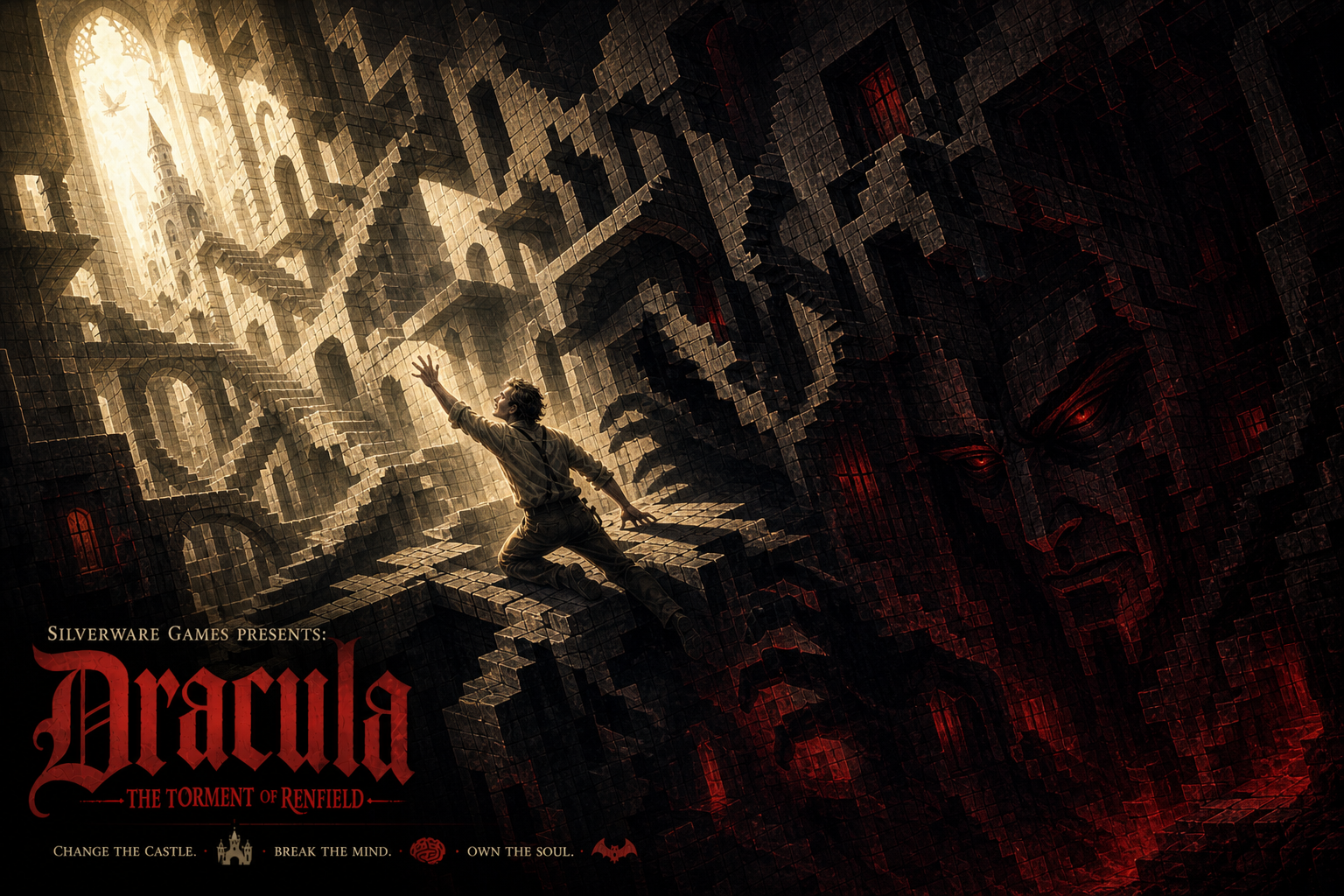
What if Dracula was not merely a monster in a cape, but the will of the castle itself? In Silverware Games' Dracula: The Torment of Renfield, you do not chase your prey through the halls with claws and fangs. You haunt him. You watch him through cracked portraits, trembling mirrors, rats in the walls, and moonlit windows. Renfield is trapped inside your living Transylvanian labyrinth, desperate to escape before the castle finishes learning his fear. He is not a mouse, but he becomes mouselike: skittish, clever, hunched over a lantern, sniffing out safety where none exists.
The game is a reverse-horror strategy experience where you play as Dracula's presence inside the castle. Renfield is controlled by AI and pathfinding systems: he searches for exits, follows light, avoids danger, remembers routes, and slowly adapts to your tricks. Your job is not simply to kill him. That would be crude. Dracula wants surrender. You reshape staircases, seal passages, fold impossible rooms into each other, whisper through walls, extinguish candles, bait him with hope, and turn the architecture itself into an argument he cannot win. Every move is psychological pressure: fear him, confuse him, fascinate him, then break his resistance.
The castle is not a generic dungeon. It is Monument Valley if the architecture hated you, filtered through German Expressionism, gothic horror, and isometric pixel strategy. A staircase is not just a staircase; it may be a 64x64 tile that rotates, inverts, lies, or leads somewhere it has no right to lead. A window may reveal moonlight, a false exit, or Dracula's eyes. A chapel may fold into a crypt. A portrait may watch. A bridge may connect only when Renfield believes in it. The visual goal is a modular tileset that locks together cleanly like a strategy board, but feels like a cursed machine built from shadows, red glass, black stone, bone, candlelight, and impossible perspective.
The heart of the game is the relationship between predator and prey. Renfield begins as a rational escapee, mapping halls and testing doors. Then he becomes suspicious, then panicked, then superstitious, then devoted. The player manages meters like fear, suspicion, resistance, and fascination, not as abstract UI alone, but as the changing shape of Renfield's soul. If he reaches the outside world, Dracula loses. If he accepts the castle as truth, the shadows as mercy, and Dracula as master, you win.
The Torment of Renfield is a strategy game about architecture, manipulation, and gothic possession: you do not need to kill him. You need to own him.